Table of contents
A lot of manufacturing founders considering a sale share the same unspoken worry: not “will I get a fair price,” but “what happens to me the Monday after closing?” For someone who has run their company for twenty or thirty years, the idea of walking out the door and never coming back can feel almost as unsettling as the financial questions.
The good news: it doesn’t have to work that way, and with the right buyer, it usually shouldn’t.
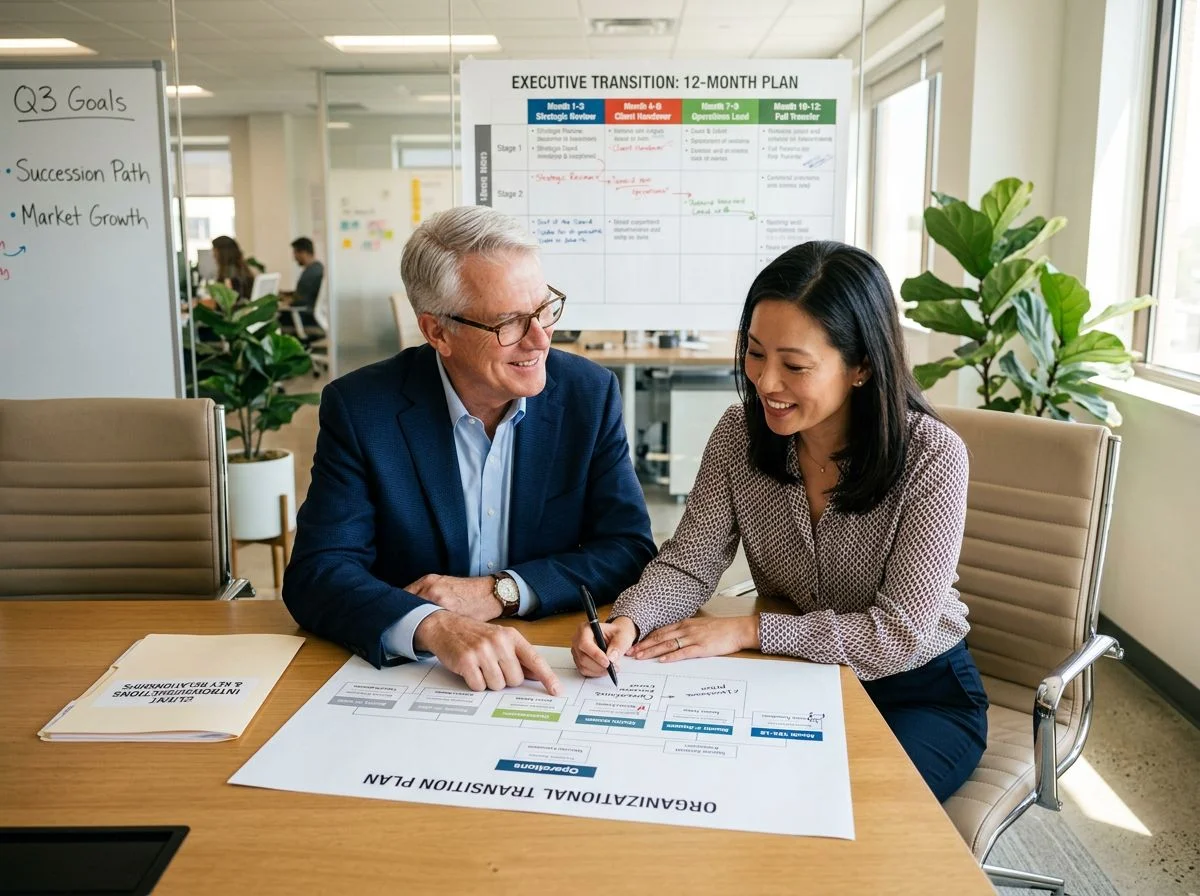
What Does a Gradual CEO Transition Look Like

There’s no single template, because every founder’s ideal involvement level is different. Some common structures:
- Extended advisory role. The founder stays on in a defined capacity, such as customer relationships, technical oversight, or board-level input, for one to three years post-transaction, gradually reducing involvement as the new leadership team gets fully up to speed.
- Operational leadership continuity. In some transitions, the founder continues running day-to-day operations for a period, while ownership and long-term capital decisions shift to the new owner.
- Part-time or project-based involvement. For founders who want more freedom but aren’t ready to fully disengage, staying involved on specific initiatives or customer relationships can bridge the gap.
Why the Buyer’s View Shapes the Deal More Than Structure

The specific structure matters less than the buyer’s actual orientation toward it. A buyer counting down to their own exit in three to five years has limited incentive to invest in a multi-year, relationship-preserving transition, because they’re already optimizing for a faster integration ahead of the next sale. A buyer with no planned exit has the opposite incentive: a well-managed, gradual transition that preserves what made the business work is directly aligned with their own long-term interest.
The research backs this up. A 2024 WTW M&A Retention Study found 72% of acquiring companies set aside dedicated retention packages to keep key people after a deal, with median payouts for senior leadership running 50-100% of base salary. But a single-year payout has an obvious failure mode: once it vests, the financial reason to stay disappears right along with it, especially if the deal never gave the person a reason to stay beyond the check. A longer, more flexible transition is a structural answer to that problem, not just a nicer one.
How We Handle the CEO Transition Process

We look for existing leadership who want to stay involved post-transaction, not because we need a security blanket, but because if a founder or leadership team has been instrumental to a company’s success, they’re going to be critical to that success continuing. Our founder, Chris Wallbank, has been on both sides of this: as the person taking over a family business, and now as the person acquiring others. That shapes how much we prioritize getting this part of a transition right.
Our flexibility on timing and structure is a real differentiator here. A PE fund needs to move fast to hit its IRR targets, which puts pressure on a quick, clean handoff. A strategic buyer eventually needs to sync your roles, compensation, and benefits with its own existing plans and policies, which constrains how much flexibility it can offer. We don’t have either constraint, so we have the room to build a succession plan around what you actually need and make sure you’re comfortable with it before it’s final. Learn more about our approach and philosophy here.
Still Have Questions?
We’re happy to answer any questions about our approach, acquisition criteria, or how we might be the right home for your business.
Get in Touch